Average price
Price affects entry point, financing, and cash-on-cash potential. A low price alone is not enough, but it shapes the whole deal.
The best rental ZIP code is not just the one with the cheapest homes or the highest headline rent. Investors need to compare rent, price, cap-rate direction, listing volume, and overall market context.
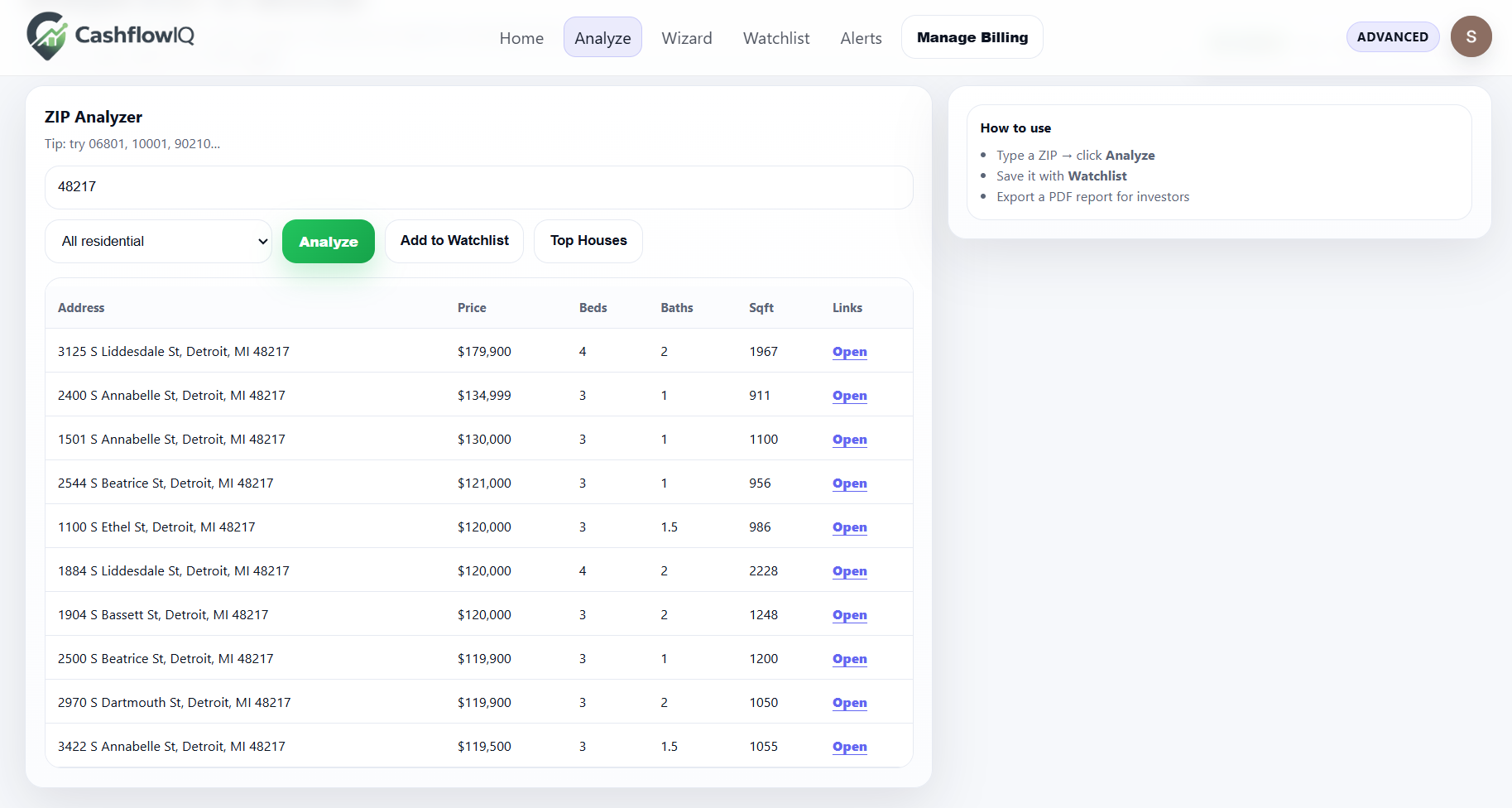
These are the metrics that help you avoid chasing weak markets or overpaying for attractive-looking rent numbers.
Price affects entry point, financing, and cash-on-cash potential. A low price alone is not enough, but it shapes the whole deal.
Rent needs to support the acquisition cost and your operating assumptions. CashflowIQ helps you review the rent side before deep underwriting.
Cap rate is not the only metric, but it is one of the fastest ways to see whether income and price are aligned.
Sales and rental listing counts help you judge whether the ZIP has enough activity to trust the signal.
A score can help summarize multiple inputs, especially when you are sorting through many ZIP codes quickly.
Single-family and multi-family signals can differ. Comparing the right property type matters.
Start with a short list of target metros, then compare ZIPs within those markets. Once a ZIP looks promising, save it, share it, or take it into a deeper analysis flow. This is where software is more helpful than a giant spreadsheet with disconnected tabs.
| Question | Why it matters | What to review in CashflowIQ |
|---|---|---|
| Is the price low enough? | Entry price drives financing and potential returns | Average and median price |
| Can rents support the deal? | Rental income is the engine of cash flow | Average rent and cap-rate direction |
| Does the ZIP have enough activity? | Thin inventory can make data less reliable | Rental and sales listing counts |
| Should I save this market? | Good markets are easy to forget during research | Watchlists, alerts, and public snapshot sharing |